The Maize Was Inherited
Food Investigation · Road to Kisumu
I still remember to this day, Maria watching us move in from her living room window. I could tell she was a few years younger than me, she did not wave, but she'd smile when I’d look up and saw her watching then she'd duck out of the window, only to return moments later. She just watched us carry furniture up the walkway from the U-haul truck into the house, one piece at a time, it's as if she knew our presence was going to change the shape of this street.
Years later I was the one standing still and watching her and her mom do work in the kitchen. Her mother would set up to work the maize, and I would find a reason to be in that kitchen with nothing to do. Maria had no interest in it. She would take another job, often working on the filling, the wrapping, making rice, sneaking liquor into our soda or juice, or whatever was happening at the other end of the counter, and leave her mother to the grinding. It bored Maria I remember. To her it felt outdated when you could just grab processed maize in a bag at the market on the corner, but her mother enjoyed the traditional way, said it tasted better, and was free of all the rubbish added to extend the shelf life. I was intrigued by the process, it felt therapeutic, I couldn't look away from it.
I feel that's important to put down, because it explains the rest. The person with every claim to that knowledge found it dull. The person with no claim to it at all stood there memorizing. I have never once processed maize with my own hands, but I have watched it done more times than I can count.
By then our mothers were familiar with each other and we ate at each other's homes regularly especially on holidays and birthdays. We taught them fried chicken, gumbo, cornbread, and greens. They taught me masa, tamales, sopas, pupusas and more. Not all of it was Mexican. Some of it was food they had picked up from other Latin American kitchens and liked enough to keep. Nobody at that table was cooking strictly within their own inheritance, and nobody even had a second thought about it. We had settled on cooking the foods we enjoyed.
Some nights her mother would grind the maize. Other nights we convinced her to relax and opened a bag of flour and added water. Neither one was treated as the real version. The bag was not a shortcut and the grinding was not a ceremony. They were two ways of getting dinner on the table, and the choice between them was about the energy of evening, not about authenticity.
I learned ugali much later, and I learned it through a phone. I found my love for Kenya on TikTok. I fell for the country the way you fall for something that feels like home, and then I kept going, and the falling has turned into something I have now organized my life around. I learned to cook ugali from videos made by people I have never met. I learned githeri the same way. I wrote about githeri here, a couple of weeks ago, with some confidence. It was while I was working on that piece that I noticed what I had been eating in both houses was the same grain.
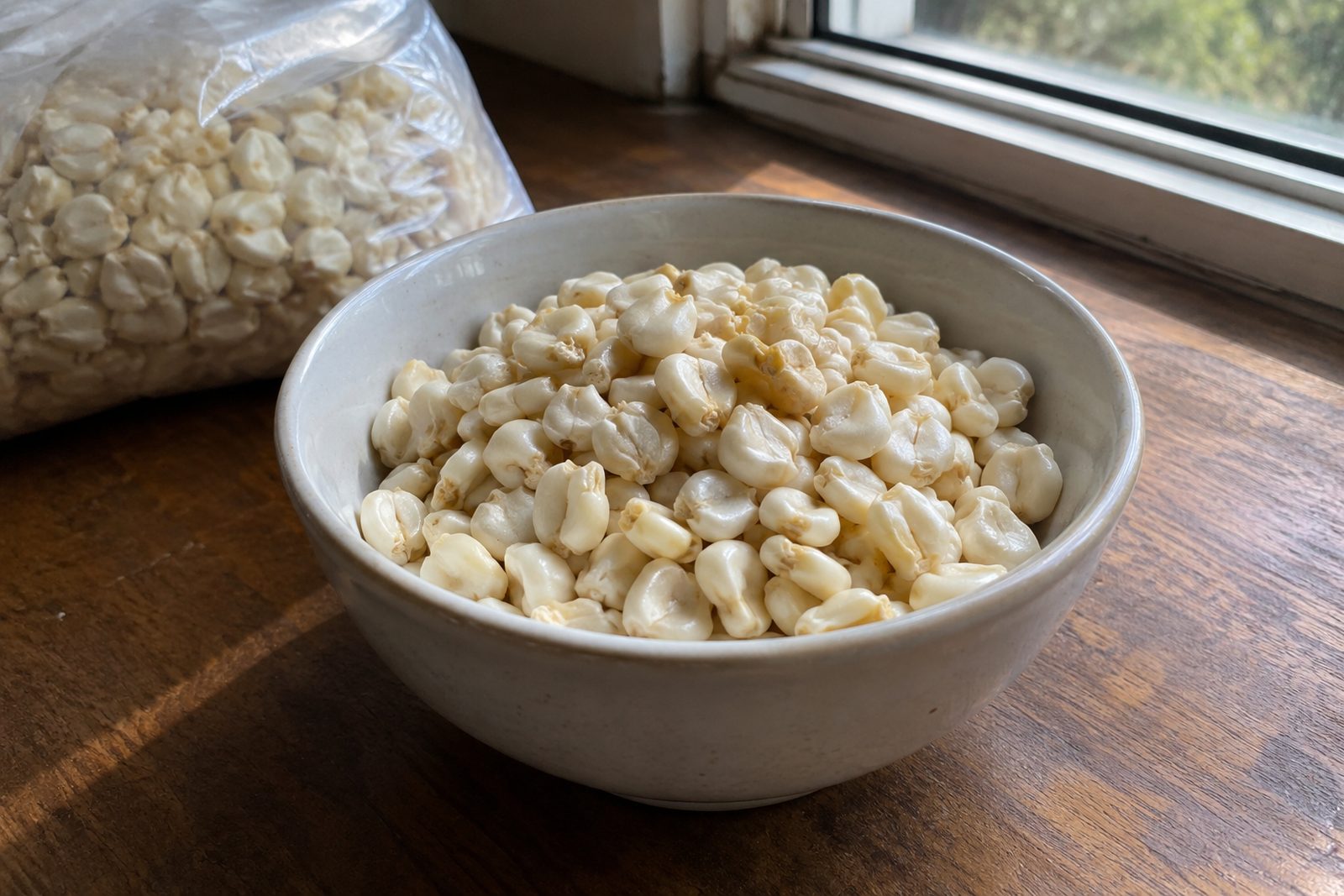
Maize is American. It came out of Mesoamerica, and every kernel of it anywhere in the world descends from that. I knew this the way everyone knows it, which is to say I had never once even thought about it. I had spent twenty years moving between two kitchens on either side of a fence, and I had not noticed that the thing at the center of both of them had crossed a large land mass to get to them. Maize played a role in both of our homes, we enjoyed it on my side of the fence as cornmeal in cornbread, soft whole maize as hominy in eggs, and many other foods including grits, even the fried fish and chicken we shared with Maria's family was coated in a mixture of all purpose flour and cornmeal, and of course on her side of the fence those traditional Latino dishes. So I went looking for how it got to Kenya, and the answer is not the one I expected, and it is not mine to soften.
Maize reached East Africa long before the British did. It shows up in the record by the sixteenth and seventeenth centuries, and archaeological evidence puts it in the Kenyan interior by the seventeenth century. Marvin Miracle, whose 1965 study in the Journal of African History is still the standard account, is careful about the routes and dates, the crop probably entered tropical Africa at more than one point and at more than one time, and the record does not support precision beyond that.
What Miracle also found is that maize stayed marginal there for a long time. Across most of eastern and central tropical Africa it was not a significant export and not what people mainly ate, well into the twentieth century. It was present, but it was not the staple. In Uganda it appears to have been unknown as late as 1861.
The grains that fed people in that region, and the grains that moved along its trade roads were sorghum and millet. In the nineteenth century, caravans crossed the interior carrying ivory, cloth, beads, and enslaved people to the coast. The men who carried the loads were overwhelmingly not slaves. Stephen Rockel's work established that they were professionals for the most part, they bargained, and they refused to march when the terms were bad. The association between porterage and slavery was a European story that made intervention easier to justify.
The porters were paid partly in food. A daily grain ration, issued to a working man, called posho. In the caravan era that ration was generally sorghum or millet. One economic history of maize in the region traces the word posho itself back to the English word portion, which if it holds is the whole thing in a single syllable, the word for the food is the word for the amount you are given. Migrant labour was already there. The ration was already there. The word was already there. What the colonial administration did was change what went in the bowl.
The mechanism was not an order to eat maize. There was no such order. What there was instead was a tax payable only in cash, in an economy that did not run on cash. The Hut Tax arrived in 1901. The Poll Tax followed in 1910 to reach the men the first one missed. A Masters and Servants Ordinance in 1906, modelled on Transvaal law, made breaking a labour contract a matter for the courts.
The arithmetic is worth sitting with, because it is the argument. In Nyanza in 1922, the average household earned about four shillings a year from selling what it grew. The annual hut tax was twelve shillings. Earnings climbed slowly, seven shillings by 1935, nineteen by 1940, and it was not until 1936 that the average household could cover the tax from farming alone. Those are estimates drawn from provincial reports rather than measurements, and the historians who assembled them say so, but the gap they describe held for more than a decade, and the only way across it was to leave.
Nyanza sent the long-term migrants. Not the largest number of workers, most of those came from the Kikuyu reserves and went out for a few months at a time, but the men who went furthest and stayed away longest were Luo and Luhya, because sisal and tea needed hands year-round in a way coffee did not. Kisumu is in Nyanza. The place I am moving to is the place the men left from, and when they arrived, they were fed posho. The word survived. The grain in it did not. On the coast, plantation workers received a ration of maize meal or rice as part of their pay, the archives record men at a sisal estate outside Mombasa earning six rupees with posho in 1912-1913, twelve shillings a month with posho by 1923. Settlers and administrators had settled on maize meal as the cheapest adequate way to feed a working man, and the ration is where the taste for it was learned, one bowl at a time, by men a long way from home.
There is a moment where you can watch the switch happen. During the First World War, famine hit, and farmers ate their millet seed. Seed is the thing you don't eat. When the next season came there was maize to plant and not much else, so they planted maize. Maize also asks less. It grows on an enclosed cob, where sorghum stands exposed and needs someone to keep the birds off it, and that someone was usually a child. The children were in school. The men were gone. Women were left holding food production on their own with everything else still on them. Under those conditions the easier crop wins, and it is not a mystery why, and it is also not a preference.
Here is the part I keep turning over. Maize on its own is a poor foundation. Its protein is short on lysine and tryptophan, which is why populations that eat maize and very little else run into trouble. In Mesoamerica the answer was nixtamalization, soaking the grain in an alkaline solution, which frees bound niacin and improves what is available in the protein. That process traveled north with the crop to the states, but never traveled east to Africa. There is no sign of it anywhere in the East African records.
The Food and Agriculture Organization's position on maize protein is that legume protein complements it well, with the best ratio somewhere around thirty parts beans to seventy parts maize. Githeri is maize and beans. I want to be careful here, because the tidy version of this sentence is a lie. Nobody I can find says that anyone chose beans because they understood the amino acid problem. That knowledge did not exist. What is true is narrower and, I think, better. People cooking with what they had arrived at a combination that works, and the science caught up to them later. The pot got there first.
The beans were not incidental. In the Kenyan uplands before colonial rule, a wide range of bean species was grown, and women grew multiple varieties in the same field, saving multiple seed stocks as insurance against disease and bad weather. Githeri and irio were built on that variety. Among the beans was njahe, an indigenous black bean cultivated by women, believed to increase fertility and to have curative properties for mothers after childbirth. It grew on Ol Donyo Sabuk, which in the Kikuyu religion is the second most important dwelling place of the Creator, and it was used in divination.
So when I say maize became the staple, I mean something more than one grain beating another. The variety it was set against included a bean women grew, that women's medicine ran through, that had a mountain attached to it. None of that is settled by githeri being good, and githeri is good. Making something your own does not close the account. Both facts sit on the same page, a grain was made compulsory by conditions built on purpose, and people took it and cooked something worth eating out of it. The second does not pay off the first. It is just also true.
I do not have a way to end this that resolves it, so I will end it with what is planted.
Kenya grew 45.8 million bags of maize in 2025, up from 44.8 million the year before. Millet came in at 800,000 bags, up about fourteen percent. Sorghum was at 2.7 million bags the year before that, itself up nearly a quarter.
Both of the old grains are climbing. Neither is close to coming back, and neither has gone anywhere.
The grain that got carried up the caravan roads is still in the ground. It is just not what anybody means anymore when they say food.
— Chef Dumela